Steyer would be California's most progressive governor, Becerra would be a step backwards

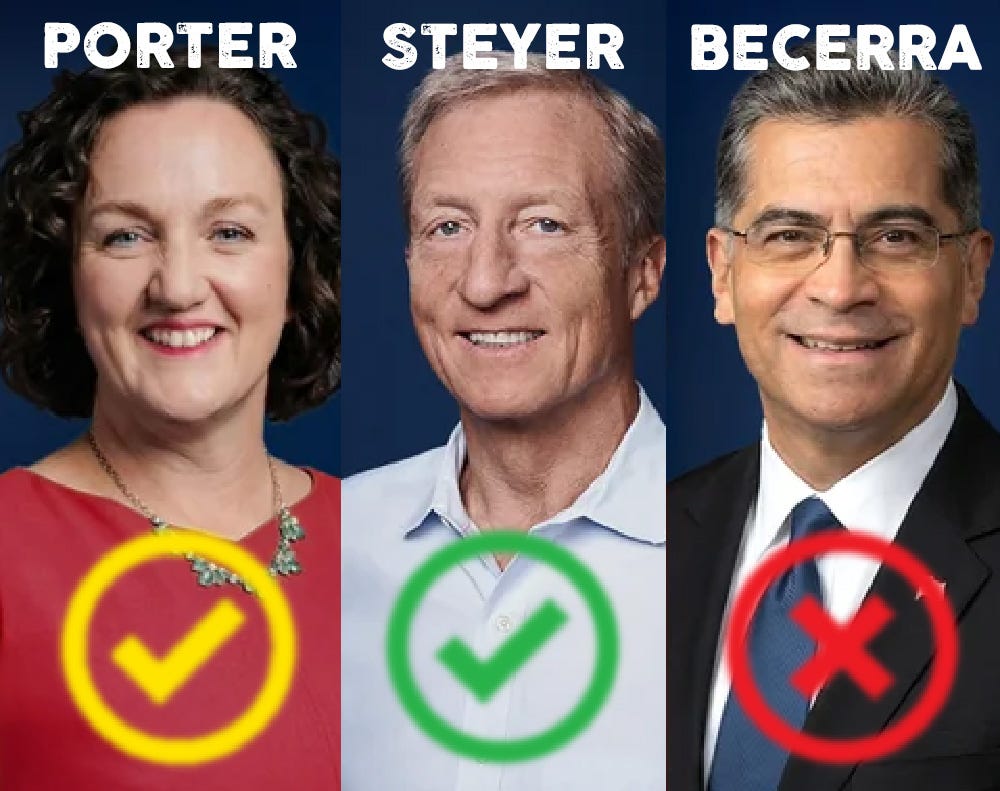
This is the most consequential California governor’s race in a generation, and the two leading Democrats are not interchangeable. One of them would be the most progressive governor in the state’s history. The other would be a step backwards. I’ve gone through this campaign issue by issue, following the records, the endorsements, and the money. What follows is that comparison. On nearly every issue that matters to me, Steyer comes out ahead, and Becerra represents the corrupt corporate establishment. I’m voting for Tom Steyer. Here’s why.
The issues:
ENVIRONMENT
I was raised in a family of environmental activists. When I was 12 years old I campaigned door-to-door for the UK Green Party. From 15-17 years old I worked for Greenpeace in England. I was later involved in other environmental movements in England and the United States.
I want a livable planet for future generations. Climate change is the biggest threat we face, and California plays a major role in shaping climate policy far beyond its borders. What California chooses to do can influence national standards, global markets, and the direction other governments take. That gives us a responsibility to lead with urgency, seriousness, and ambition.
Greenpeace’s Climate Scorecard gave Steyer and Porter an A and Becerra a D. The Center for Biological Diversity Action Fund’ Environment Rating gave Steyer an A, Porter a B+, and Becerra a C+. If you can’t get yourself to vote for Steyer because he’s a billionaire, then vote for Porter instead. Becerra is a vote for environmental destruction.
STEYER is running to defend California’s climate goals, tax oil industry profits, and break up the monopoly power of the state’s investor-owned utilities. He brings a long record to those positions: he has spent more than $62 million backing California climate ballot measures, founded NextGen Climate, and helped defeat Big Oil’s 2010 Proposition 23, the effort to suspend the state’s landmark climate law.
That record has drawn broad support from the environmental movement. The climate and environmental organizations backing Steyer include Sierra Club California, California Environmental Voters, the NRDC Action Fund, the Climate Center Action Fund, the Center for Biological Diversity Action Fund, the Jane Fonda Climate PAC, Bill McKibben’s Third Act, Food & Water Action, Climate Action California, and Sonoma County Conservation Action — alongside Greenpeace, which gave him an “A” on its Climate Scorecard.
The individual endorsers tell the same story: he has the climate establishment behind him. Among those publicly backing him are Bill McKibben (the climate activist and 350.org co-founder); John Podesta, former White House Senior Advisor for Clean Energy Innovation and Implementation; Jared Blumenfeld, the former California EPA Secretary; Mike Brune, former Executive Director of the Sierra Club; Ali Zaidi, former White House National Climate Advisor; Jigar Shah, former Director of the U.S. Department of Energy’s Loan Programs Office; Leah Stokes, the UC Santa Barbara environmental-politics scholar; David Kieve, President of EDF Action; and Gene Karpinski, longtime national climate leader. The bench is essentially the entire mainstream U.S. climate establishment.
His utility-reform agenda has made him a target: PG&E has poured more than $12 million into opposing his campaign — a historic level of spending for the utility in a governor’s race.
BECERRA is open to rolling back California’s climate goals, and is the only candidate in the race to have taken significant career contributions from all three of the state’s investor-owned utilities — more than $150,000 combined from PG&E, Southern California Edison, and San Diego Gas & Electric — alongside support from oil companies including Chevron. Those ties run the length of his career: he took energy money from Sempra as attorney general and larger sums from Edison International during his years in Congress. And they aren’t confined to his past offices. His current campaign’s own filings show direct contributions from the PG&E, Edison International, and Sempra Energy PACs.
His posture toward the industry is explicit. Asked last month why he accepts oil money, Becerra defended Chevron directly: “Chevron is not the bad guy. You need Chevron, I need Chevron, my people of the state of California need Chevron.” He’s talking about one of the most environmentally destructive companies in history.
That stance has a long record behind it. In 2017, as New York and Massachusetts pursued ExxonMobil over decades of climate deception, environmental groups, some 70,000 petition-signers, and 18 California members of Congress — led by Jared Huffman and including Ted Lieu — urged the newly sworn-in attorney general to open a parallel inquiry. Becerra declined — he lent his name to an amicus brief backing New York City’s suit, but never opened California’s own investigation or filed its own case. His successor, Rob Bonta, ultimately did in 2023.
The money has only deepened this cycle. Chevron maxed out to his campaign — the first gubernatorial candidate it has backed in a decade — and, unlike Katie Porter, Becerra has refused to sign the pledge rejecting fossil-fuel contributions. Steyer has called on him to return the Chevron check. Since then, the oil money has grown far beyond that direct donation: Chevron has put in $1 million across two $500,000 checks on May 22 and May 26, and California Resources Corporation — the state’s largest oil driller, spun off from Occidental Petroleum and out of Chapter 11 bankruptcy as recently as 2020 — another $500,000, into a pro-Becerra independent committee bearing the incongruous name “Working Families for Healthy Communities.”
He has gone further on the trail. At a May debate, Becerra said he would support reopening oil drilling in Kern County — reversing the position he held as attorney general, when he fought federal lease sales there.
HEALTHCARE
If you’re like me and can’t afford healthcare, the two leading Democrats in the California governor’s race are on opposite sides of the issue that matters most to you.
STEYER wants state-run single-payer. He’s pledged to pass the single-payer legislation backed by the California Nurses Association — and the CNA has endorsed him. So have single-payer’s biggest champions: Rep. Ro Khanna, Assemblymember Ash Kalra (author of CalCare, the state single-payer bill), and Our Revolution, the group founded by Bernie Sanders allies.
BECERRA has backed away from it. He’s endorsed by the California Medical Association — one of the most powerful opponents of state single-payer. The CMA’s president said Becerra told doctors in a private meeting “very clearly that, at this point, he wasn’t supportive of single-payer.”
The healthcare industry is funding him directly. These groups are maxing out to his campaign: the California Medical Association, the Physician Association of California, and the community-health network AltaMed. They’re joined by hospital operators (Prime Healthcare, Adventist Health, and Kaiser Permanente executives) and a cluster of private-ambulance companies — American Medical Response (the operating arm of Global Medical Response, which separately put $500,000 into the pro-Becerra committee), plus the California Ambulance Association, Medic, Royal, and Life West.
The same industry stacks the pro-Becerra independent committee. On top of the CMA’s $1.3 million and Global Medical Response’s $500,000, it took $500,000 from the dialysis company DaVita, $100,000 from the insurer Centene (parent of Health Net), and checks from Allied Physicians of California and the California Primary Care Association.
CRIMINAL JUSTICE
I spent 7+ years in prison for psychedelics. I was incarcerated at 3 different private prison facilities for almost 5 years of that sentence, living in a tiny cubicle like the one pictured in this post. I’ve been a lifelong criminal justice reform advocate. I endorse Tom Steyer for California governor because he has the best criminal justice platform.
STEYER wants rehabilitation over incarceration. He calls California’s history as a national leader in mass incarceration “racially unfair and dehumanizing,” and backs treatment and rehabilitation over prison for nonviolent offenders while keeping violent offenders locked up. Through his group NextGen, he helped pass state reforms that lowered sentences and expanded reentry programs. He supported the treatment-not-incarceration goal of Prop 36 but argues the state never funded it properly. On criminal justice specifically, he’s endorsed by Smart Justice California, a progressive criminal-justice advocacy organization, along with Assemblymembers Isaac Bryan, Lola Smallwood-Cuevas, and Mia Bonta — all authors of prison-reform bills. He also carries the broader endorsement of Courage California, the state’s largest progressive advocacy group.
His record has one real complication, which he’s owned: Farallon, the hedge fund he founded, held a stake of roughly $90 million in private-prison company CCA (now CoreCivic), peaking in 2005. Steyer has repeatedly called the investment a mistake, says he ordered it sold (Farallon divested by 2006), and left the firm in 2012. He frames it as a turning point toward his reform work — pledging to avoid private-prison investments and backing efforts to end cash bail in California. In his 2020 presidential run, he campaigned on a broader anti-bias platform: ending solitary confinement, funding reentry and community-policing programs (including a proposed $600 million juvenile-justice bureau), restoring voting rights for formerly incarcerated people, and reversing Trump-era policies which gave prosecutors power on lower-level drug sentences.
In this race, the prison-guards’ union — the California Correctional Peace Officers Association — has put $25,000 into a committee working to defeat him. That $25,000 is part of a broader stream of correctional-officer money behind the main anti-Steyer super PAC, “California is Not for Sale,” which has lately pivoted to boosting Becerra directly. The CCPOA’s involvement isn’t disclosed in the PAC’s attack ads — a contradiction one Democratic consultant flagged, since prison guards are attacking Steyer over the prison investments he’s disavowed while helping fund the campaign against him.
BECERRA’s record is one critics call among the least progressive on policing. After the SB 1421 transparency law took effect in 2019 — ending the era in which California was the only state to seal all police-misconduct records — his office refused to release the Justice Department’s own pre-2019 files on officer shootings, sexual assault, and dishonesty. That prompted the First Amendment Coalition, later joined by KQED, to sue him in February 2019. His office also sent UC Berkeley journalists a letter threatening prosecution and demanding they destroy a lawfully obtained database of officers’ criminal convictions.
When Sacramento police killed Stephon Clark — an unarmed 22-year-old holding a cellphone in his grandmother’s backyard — Becerra’s office reviewed the shooting and declined to charge the officers. And although he voted in 2016 to abolish the death penalty, his office fought to uphold death sentences even after Newsom’s 2019 execution moratorium. The starkest example: Robert Lewis, a Black man sentenced to death in 1991. Becerra’s office pressed the state Supreme Court to artificially inflate Lewis’s IQ so the state could execute him, fighting his defense’s evidence of intellectual disability. This racist tactic failed — the court overturned Lewis’s sentence in 2018, and two years later the legislature banned race-based IQ adjustment in capital cases.
His office also declined to investigate the Vallejo police killing of Sean Monterrosa, a 22-year-old shot in the back of the head — a case his successor later took up and the city settled for $8.5 million. Becerra’s office opposed a 2020 bill requiring independent state investigations of police killings, and passed on an Orange County jailhouse-informant scandal that drew a federal inquiry.
That record sits alongside his backers. KQED reports police unions have been among Becerra’s major financial supporters throughout his career, and Jason Paladino — one of the journalists his office threatened — said they’re a constituency Becerra “feels somewhat beholden to.” As attorney general, he took more than $300,000 from law enforcement unions, and the prison-guards’ union — the California Correctional Peace Officers Association (CCPOA) — routed $320,000 through an independent group backing him and other candidates that cycle. In this race, the Richmond Police Officers Association has chipped in to a committee working to elect Becerra. His campaign also paid to appear on the “COPS Voter Guide” — a for-profit, pay-to-play mailer that mimics a police endorsement.
ISRAEL & AIPAC
STEYER has made AIPAC a campaign issue, calling it “a dark money organization that should have no place in our politics” and reaffirming the stance since — casting AIPAC as a group that attacks progressive Democrats and cheers on Trump and Netanyahu’s war.
BECERRA has stayed deliberately noncommittal: he has not denounced AIPAC or pledged to refuse its support. Reporting describes his posture toward Israel and the pro-Israel lobby as institutionalist.
HOUSING
I want a California where someone with an ordinary job can actually afford to live here.
STEYER has one of the strongest housing platforms in the race. California YIMBY rates it among the best in the field. He publicly backed the SB 79 transit-density bill while it was still being fought over, pledges to build a million homes, and would raise roughly $20 billion a year by closing a corporate tax loophole — money he’d use to reward cities that build, favoring incentives over suing the cities that don’t. In May 2026, the Santa Barbara Independent’s editorial board endorsed him, calling his housing platform the field’s clearest read on the affordability crisis and its most cogent fix.
The pro-housing coalition has lined up behind him: YIMBY Action, Abundant Housing LA, Streets for All, and the Abundance Network all endorse Steyer. So does the California Conference of Carpenters — the construction union that broke from the State Building and Construction Trades Council over density bills because California needs more homes built, not just stricter conditions that make building harder. The union actually wielding the hammers picked the pro-housing candidate.
BECERRA is seen by many housing advocates as a campaign-season convert. He endorsed SB 79 only after it was signed, not during the legislative fight. He conditions faster building on rules that YIMBYs warn drive up costs, and leans on limits to corporate home ownership that analysts say won’t move affordability much because institutional investors hold under 3% of California homes.
The money around Becerra reflects the industry’s stake: a $24 million, real-estate-backed group, “California is Not for Sale,” is spending to defeat Steyer; the California Association of Realtors is the pro-Becerra committee’s single largest donor at $2.75 million, and has separately poured about $7 million into the anti-Steyer effort; and the California Building Industry Association has added another $1 million to the campaign against Steyer.
Advocates also fault how Becerra used the office itself: he joined 2021 lawsuits to block San Diego County developments and, by YIMBY Action’s account, touted using CEQA — a favorite tool of anti-housing forces — to stop a San Diego project. Becerra earned a “C” on YIMBY’s housing scorecard.
IMMIGRATION
These are my neighbors, and I won’t back a governor who treats them as someone else’s problem.
STEYER has taken the hardest line in the field, calling ICE “a criminal operation” and saying plainly, “I’m for abolishing ICE.” His plan would ban racial and occupational profiling, fund a special investigative unit and give the attorney general authority to investigate and prosecute ICE agents for abuses, expand state-funded legal defense for undocumented Californians, and run a statewide know-your-rights campaign; Courage California, which endorses him, backs abolishing ICE outright.
BECERRA points to his record suing the first Trump administration more than 120 times and pledges to “police the immigration police” by investigating and prosecuting agents who break the law — but stops short of Steyer’s call to abolish ICE, a more incremental posture his rivals have pressed him on.
His bigger liability on immigration is the record he ran himself. As Biden’s Health and Human Services secretary, Becerra oversaw the federal agency responsible for placing unaccompanied migrant children. A New York Times investigation found that, amid record arrivals, he pushed staff to move kids out of crowded, makeshift shelters faster — leading employees to loosen long-standing sponsor-screening protections (the department denied compromising safety). On a 2022 staff recording later obtained by the Times, Becerra pressed for speed himself, likening the operation to an assembly line and complaining that Henry Ford “would have never become famous and rich” working this slowly. HHS’s own inspector general later found the rushed guidance had stripped safeguards and may have raised the risk of placing children with unsafe sponsors.
The scale of it: HHS rushed to release roughly 250,000 children, then did little to learn what became of them — failing to reach about a third of them, some 85,000, on the single follow-up call it typically made. Many of those children weren’t living with parents but with sponsors who pushed them to work, often to pay off debts the sponsors themselves charged — for travel, clothes, meals, lodging — with monthly interest. Thousands ended up in punishing jobs illegal for minors: cleaning slaughterhouses, working lumber mills, roofing. Children died or were catastrophically injured after release — among them Andrés Toma, 16, who fell to his death three months after being placed with an uncle; Antoni Padilla, 15, who lost the ability to speak after falling from a roofing job; and Marcos Cux, released by HHS at 13, whose arm was torn open by a machine at a chicken plant. Inside HHS, staff repeatedly warned that children appeared to be at risk, in reports that reached Becerra’s level.
He dismisses the criticism as Trump lies and insists that what happened to the children after they left federal custody “was not on my watch.” Pressed by the Times on what his handling of the crisis said about his fitness to govern, Becerra didn’t defend his own agency’s record — he pivoted to Trump’s family-separation policy and claimed he’d done better by comparison. But family separation was run by the Department of Homeland Security, not HHS. Asked to account for the one agency he actually led, he answered by measuring himself against a program he had no hand in — changing the subject instead of answering for his own.
BIG TECH
The same handful of companies shaping our lives, our jobs, and our democracy shouldn’t also be writing the rules they live by.
STEYER has the most developed Big Tech platform in the race and runs as an industry adversary: he’d impose a “token tax” on AI — billing companies “a fraction of a cent for every unit of data processed” — to seed a Golden State Sovereign Wealth Fund, require data centers to pay their own way, and pair it with a jobs guarantee, built with the unions, for workers displaced by AI. Drawing on the Common Sense Media work of his brother Jim, he backs mandatory AI safety testing, stricter social-media age verification, and barring children under 16 from social platforms. The Secure AI Project, which advocates for AI policy that serves the public rather than the industry, endorsed him on that platform. After Meta disclosed a $950,000 check on May 19 to a pro-Becerra committee — pointedly named “Working Families for Healthy Communities” — hours before announcing layoffs of about 10% of its workforce, Steyer’s response was blunt: “Mark Zuckerberg wants a friend in Sacramento. I won’t be.”
BECERRA is the tech industry’s preferred Democrat now that Silicon Valley’s first pick, Matt Mahan, has faded — Meta put roughly $950,000 into a pro-Becerra committee on the eve of its mass layoffs, Airbnb added $1 million, and on May 22 and May 26 Uber’s California PAC dropped two $1 million checks into a newly stood-up pro-Becerra vehicle, “Latinos United for Xavier Becerra for Governor 2026.” That makes Uber the largest single tech donor to the pro-Becerra operation, ahead of Meta and Airbnb. Meta’s money runs both ways against Steyer: it’s also among the top donors to JOBSPAC, the Chamber of Commerce PAC pouring $11.75 million into the drive to defeat him. As attorney general, critics say he was among the last AGs in the country to join the antitrust investigations into Facebook and Google; his AI plan flags chatbot harms such as the promotion of self-harm but commits to no new laws, pledging only to “hold accountable any company willing to put profits ahead of children’s safety,” and he has proposed no tax on AI or tech wealth.
LABOR
I want a governor the people who actually do the work trust to be on their side.
STEYER has consolidated the unions whose members deliver public services. Education and care: the California Teachers Association (310,000 members), the California Federation of Teachers (120,000), the California School Employees Association (248,000 classified school workers), the California Nurses Association (around 100,000 California members), and the United Domestic Workers (UDW/AFSCME Local 3930) — the 250,000 in-home care and child care providers, which cited his plan to protect and invest in In-Home Supportive Services and family child care. The University of California workforce: AFSCME 3299, UC’s largest employee union with about 30,000 service workers, and UPTE-CWA Local 9119, representing roughly 17,000 UC professional and technical employees. Service and creative work: UNITE HERE Local 11 (about 32,000 hospitality workers across Southern California and Arizona), IATSE (entertainment-industry crews in film, TV, and live events), IFPTE Local 21 (Bay Area professional engineers and technical staff), and CASE — the state attorneys, administrative law judges, and hearing officers. Plus the California Conference of Carpenters — the construction union that broke from the State Building and Construction Trades Council over density bills — along with the North Coast States Carpenters Union. He also holds a co-endorsement from SEIU California (about 750,000 members, a Steyer/Becerra split the union landed on after rescinding its earlier solo endorsement of Swalwell), and was one of four candidates the 2.3-million-member California Federation of Labor named in its pre-primary endorsement, alongside Villaraigosa, Porter, and Swalwell (whose campaign has since collapsed).
BECERRA has consolidated the institutional power centers of organized labor — the building trades, the doctors’ and dentists’ guilds, public safety, longshore, and the grocery establishment. Building trades: the California State Council of Laborers (LIUNA), the California State Pipe Trades Council, the IBEW California & Nevada State Association of Electrical Workers, and UA Local 339. Public safety: the California Professional Firefighters. Longshore: the ILWU Southern California District Council and Locals 13, 63, 94, 29, and 56 — the regional council and main port locals at LA/Long Beach. Healthcare professionals: the Union of American Physicians and Dentists, and the United Nurses Associations of California / Union of Health Care Professionals. Plus UFCW Western States Council (grocery), AFSCME District Council 36 (LA-area public workers), SEIU Local 87 (SF janitors), and the shared SEIU California co-endorsement. The California Faculty Association co-endorsed him alongside state Superintendent Tony Thurmond rather than picking him outright. The Laborers connection runs through the money too — a Laborers Pacific Southwest PAC put $2 million into the main pro-Becerra independent committee, its second-largest single donor.
Strip out the shared SEIU co-endorsement and the headcount comes out roughly 3-to-1: Steyer’s labor coalition totals approximately 1,250,000 members; Becerra’s about 410,000. But the more revealing distinction isn’t the number — it’s whose members each candidate has consolidated. Steyer holds the unions whose members ride the buses, clean the schools, staff the wards, run the kitchens, and build the sets. Becerra holds the Sacramento establishment apparatus: the building-trades councils, the police-adjacent firefighters, the doctor and dentist guilds, the longshore councils, the grocery establishment — the same institutional power structure that has funded his career from the start. The clearest tell is the California Federation of Labor itself: with four endorsement slots open, the 2.3-million-member federation still didn’t include Becerra.
ENTERTAINMENT
California built the entertainment industry, and is now losing it. The next governor either fights for the production jobs that built this state or watches them keep walking.
STEYER has the actual entertainment-industry workforce behind him. IATSE — the union representing entertainment crews in film, TV, and live events — endorsed him, citing his commitment to “keeping production in California in live events, film and TV.” Without immediate action, the union warned, California risks losing the jobs and infrastructure that power the industry. The California Conference of Carpenters, which builds the sets, is also with Steyer. He has a published film-and-entertainment policy plan that pairs production tax incentives with union-work requirements.
BECERRA lists “Film Industry” as a priority on his campaign site, but doesn’t have a single entertainment-industry union behind him. The people who actually work on California sets — the ones who would hold the next governor accountable on production retention — picked Steyer. Becerra picked the topic.
CONSUMER PROTECTION
A governor’s job includes standing between Californians and the corporations they have to do business with — utilities, insurers, oil companies, tech platforms, healthcare networks. That requires being on the consumer side of the ledger, not the corporate one.
STEYER has the consumer-protection establishment behind him. The Consumer Federation of California endorsed him, saying he “made it clear to CFC that protecting California consumers would be a top priority” and had detailed numerous proposals to enhance consumer affordability. His platform turns that into specifics: closing a corporate tax loophole worth roughly $20 billion a year, breaking up the investor-owned utility monopolies to lower electricity bills, returning windfall oil-industry profits directly to Californians, ending the Prop 13 commercial-property loophole that lets large corporate landowners avoid reassessment, and banning corporate PAC money from California elections. Robert Reich, the former U.S. Secretary of Labor, endorsed him on the same ground, saying California needs “progressive change, not more of the same” and calling Steyer the only viable candidate to deliver it.
BECERRA is the candidate the corporations are funding. His campaign committee has reported more than $9.6 million, and the donor list reads like a directory of the industries a governor regulates: Chevron, the PACs of PG&E, Edison, and Sempra, plus checks from the dialysis industry, the private-ambulance sector, apartment and developer PACs, and McDonald’s and 7-Eleven franchisees. The pro-Becerra outside committees add another tier of the same: Meta, Airbnb, Uber, California Resources Corporation, the Realtors, DaVita, and Centene (parent of Health Net). He has no consumer-protection group on his endorsement list.
The pattern is straightforward. The groups whose job it is to protect Californians from corporate overreach picked Steyer. The corporations themselves picked Becerra.
EDUCATION
STEYER has consolidated the major education unions — he’s endorsed by the California Teachers Association, the California Federation of Teachers, and the California School Employees Association — and would fund public schools by closing corporate tax loopholes and reforming Prop 13 so commercial property is taxed at fair value. His record includes helping win universal school meals, and his proposed AI “token tax” would route money into education, job training, and apprenticeships.
BECERRA supports free community college and cites his work expanding early-childhood education as HHS secretary, plus childcare help in his affordability plan — but he hasn’t laid out how he’d address rising four-year-college tuition, and the California Faculty Association split its endorsement between him and Tony Thurmond rather than backing him outright.
AFFORDABILITY
Everything here costs too much, and a governor’s first job should be making the basics affordable again.
STEYER has built the whole campaign around cost of living: he’d close a corporate tax loophole to generate about $20 billion a year for housing, health care, education and infrastructure, return windfall oil-industry profits directly to Californians, and end the Prop 13 commercial-property loophole that lets large corporate landowners avoid reassessment — a fight he is the only candidate actively waging. A self-styled class traitor who calls himself “the billionaire who wants to tax other billionaires,” Steyer has also said he would vote for the November billionaire-tax measure — a one-time 5% levy on billionaire wealth to fund health care and schools — though he’s called it only a temporary fix.
BECERRA’s affordability pitch leans on freezing utility rates and home-insurance premiums — but he is the only candidate to have taken career contributions from all three of the state’s investor-owned utilities (PG&E, Southern California Edison, and San Diego Gas & Electric), the same companies whose rates he now promises to cap. He also opposes the billionaire-tax measure.
CAMPAIGN FINANCE
I want to know who owns a candidate before they take office — so follow the money.
STEYER is self-funding at record scale, likely the priciest campaign in California history. Critics say he’s buying the office. His counter: self-funding means he owes nothing to PG&E, Big Oil, or Big Tech — the interests now spending $50M to defeat him — increasingly the same money backing Becerra.
BECERRA gets his money from telling places. His $9.6M+ committee reads like a directory of industries a governor regulates: Chevron, all three utility PACs (PG&E, Edison, Sempra), gaming tribes, the ambulance and physician lobbies, developer money, even McDonald’s and 7-Eleven franchisees.
The anti-Steyer committee “California is Not for Sale” has raised ~$33M — $13.6M from a PG&E-funded energy group, $11.75M from the Chamber’s JOBSPAC, ~$7M from the Realtors — boosting Becerra, and attacking Steyer. The main pro-Becerra committee’s top donors total $9.25M (Realtors, building trades, Pechanga, the Medical Association, Airbnb, Meta), plus $500K from McDonald’s, pushing it past $14M. A second vehicle — “Latinos United for Xavier Becerra” — disclosed $2M from Uber’s PAC.
READINESS FOR OFFICE
I’d rather judge a governor by what they’ve actually delivered than by how long their list of titles is — and by who’s willing to stand behind them.
STEYER is not a career politician — he left the investment firm he founded more than a decade ago, signed the Giving Pledge, and has spent sixteen years winning hard fights: leading ballot campaigns that beat Big Oil on climate, closing a tax loophole on out-of-state corporations, raising the tobacco tax to fund health care, and helping advance reforms like reentry programs and universal school meals. His pitch is delivering results “even when the real politicians couldn’t get it done.”
That pitch has been validated by the people who actually serve in Sacramento and Washington. His political coalition reaches from the California Democratic Party’s progressive wing to its institutional core. From Congress: Ro Khanna, Jared Huffman, and Lateefah Simon — alongside U.S. Senator Sheldon Whitehouse from out of state. From the state Senate: Caroline Menjivar, Lola Smallwood-Cuevas, and Henry Stern, plus former Senate President pro Tempore Toni Atkins and former state senator Nancy Skinner. From the Assembly: Ash Kalra (the author of CalCare, the single-payer bill), Alex Lee (chair of the Progressive Caucus), Liz Ortega (chair of the Labor and Employment Committee), Isaac Bryan, Mia Bonta, Tina McKinnor, Dr. Corey Jackson, Damon Connolly, Gregg Hart, Tasha Boerner, Chris Rogers, Dawn Addis, Dr. LaShae Sharp-Collins, Nick Schultz, Steve Bennett, and Chris Ward. Plus former state controller Betty Yee, former San Francisco mayor Willie Brown, and Los Angeles councilmember Hugo Soto-Martínez. The pattern matters: progressive-caucus and committee chairs, single-payer and labor-bill authors, prison-reform legislators, and longtime party elders all standing in the same column. The “billionaire trying to buy the office” line doesn’t survive contact with that list — these are the people in the room when policy gets made, and they’re with him.
BECERRA has the longest résumé in the race — 24 years in Congress, four as California attorney general, four as U.S. Health and Human Services secretary — and built a national profile suing the first Trump administration more than 120 times. But that same long record is where the doubts live: the utility donations, the death-penalty and police-transparency fights, and a housing stance critics call a recent conversion all come from the very career he’s running on.
The sharpest doubts are about competence, and they come from people who worked alongside him. As his polling rose, former Biden officials began privately describing the ex-HHS secretary as ineffective and unprepared in his handling of COVID and other crises, a recurring topic in alumni group chats. Going on the record, former Biden DOJ communications director Xochitl Hinojosa said on CNN that he was “not an effective HHS secretary” and that any cabinet secretary would say the same. A former White House official who worked closely on HHS matters told NBC News that during real crises Becerra did not have the grasp of the agency or the role you want in an executive, echoing earlier criticism that he was an “invisible” secretary who ceded pandemic messaging to the CDC and White House.